Friday, July 7, 2023

Final Digital Literacy Project: PECHA KUCHA & Narrative

PECHA KUCHA Unedited Click me!! Not sure how the video ended up longer- I triple checked that the transitions were set to 20000 (20 seconds)

Final Draft: PECHA KUCHA Edited version: I sped up the playback speed to try and shorten the video length.

Transcript: outline and slides

Written Narrative

Creating this project allowed me to reflect on my educational journey. I had the chance to remember what my why was, ad this was a much-needed lesson for myself. Becoming a teacher is something that I have remained committed to since I was thirteen, when one of my own teachers helped me turn my life around. When I first set out to become an educator my goal was to instill a love of literature and language in young people by practicing socio-culturally relevant pedagogy that is centered on social-emotional learning, self-advocacy and modeling vulnerability. Working in a Title I school, I often witness students, who are already part of what educational philosopher Paulo Freire, would describe as oppressed groups, suffer in many ways.  These students have suffered from hidden learning struggles, lack of proper accommodations, language barriers, and multiple types of trauma.


Growing up, I really struggled to do well in school. I vividly remember trying so hard to stay focused, but then I would remember all of the other times I was unfocused, and the consequences (like cold calls from my teachers) and I would end up missing what was happening in real time. I was a quiet kid, in a school filled with very academically motivated students. I wanted my teachers to know me, and to understand why I was having so much trouble, but I was too shy to ever approach a teacher unprompted. Finally, about halfway through 7th grade I got lucky. My math partner for the month had a resource teacher to help them, and as a result I got to work with the teacher as well. It only took about a month of working with this resource teacher, for him to decide to contact my parents and encourage them to have me tested for a learning disability. As it turned out, I ended up being diagnosed with ADD, anxiety, and depression. Once the proper accommodations were made for me, I went from barely passing to an A/ B student. I finally felt seen, and overtime I began to participate more in class, and focus on what was happening in real time. By the end of 7th grade, my mind was made up. I was going to be a teacher, and my goal was to inspire students and make them feel heard like this resource teacher had done for me!  


I realize that my initial goal of helping students achieve their full potential, has evolved into ensuring students are provided with an equitable education, and trying to figure out how to do so while overcoming all sorts of obstacles. We learn about the dominant ideology through the acronym that Lesley Griner created to acknowledge the groups of power in the United States; straight, white, christian, able-bodied, American, Male, and property owning (SCWAAMP). When considering how oppression and oppressed groups intersect with the role in which the dominant narrative plays within our schools, one thing is clear, that English is the language of power in the United States.


Now that I am finally living out my dream career, I’ve noticed that there are so many more problems in education than I could have anticipated. Rita Pierson tells us that “kids don’t learn from people they don’t like” in her TedTalk. So I had hoped that by building strong relationships with my students, and dedicating time towards getting to know them, then it would lead to great discussions, participation, and constant engagement. But this was not the case. I could tell that many students were just going through the motions when it came to classwork, and in some ways, I was also just going through the motions as well. I had fallen into a routine with my units and lessons, trying to ensure I was doing what was expected of me with the curriculum I was given. I realized that I needed my lessons to be more engaging and interactive. But this is hard to do when the curriculum you’re given is not only boring, but also outdated. Several of the stories we read about pop culture were even older than me and made references to rent being $400 (can you imagine?).


It also didn’t help that I was doing coverage every planning period, and my time outside of school was spent either working on my TESOL courses, or running clubs (I have a bad habit of agreeing to do a lot of things and then leaving myself with very little free time). I became guilty of following the same routine with my units, and feeling too tired to wrap my head around trying to plan for anything new. At the end of this school year, I realized that I was becoming the kind of teacher that was nice, but boring. And I did not spend 13 years wanting to be a teacher, only to end up becoming a boring one. The last day of school came, and I was burnt out. I had expected to find my groove in my third year, and instead I felt that I had moved backwards in my progress towards becoming a good teacher. I gave my students another google form on May 30th, asking them what they liked doing in class, what they disliked, what they hoped to see in future classes, what topics they were interested in studying, and for any feedback they had for me. Only 22 of the 88 students I had left answered. As I read through their responses, I noticed several students asking for more interactive activities, and building more of a community within the classroom. I decided that this would be something I needed to work on this summer, but that would have to wait until I was finished with another class. I did not have high expectations coming into this course, and I was actually dreading going right from the last day of school to another course.


My previous courses had left me feeling unmotivated and frustrated that I wasn’t learning anything new, and had contributed to the burnout I was left with this past year. But instead of another repetitive course, I was met with something that was exactly what I needed. A chance to focus on my core beliefs regarding learning and how I could leverage those to create change in my classroom. I know what I believe. I believe that students learn best when there is empathy in the classroom, when there is a strong classroom community and when they feel seen and heard. Some of my core beliefs were established in previous course texts such as The Vulnerable Heart of Literacy by Elizabeth Dutro, which goes over the importance of student-teacher relationships, and modeling the type of behaviors and actions you want to see in your classroom (check out a book review here). After all, that feeling of having your voice finally heard by a teacher is what changed my own views on my education when I was growing up. After talking with my peers, and my professor, I was able to focus my ideas better. As I mentioned previously, I want to change the level of engagement in my classroom. I plan on doing this by building a stronger community in my classroom, and creating more interactive lessons for my students. But how will I do this?


I plan on building  a more interactive digital component into my classroom that will simultaneously give my students a chance to build community. The first thing I want to do is have all of my students create a blog space similar to this class, using the same platform. I will be sure to use clear instructions and build the knowledge of how to use this digital feature with my students. As we learned in Danah Boyd’s chapter, “youth need opportunities to develop the skills, and knowledge to engage with contemporary technology effectively and meaningfully. Becoming literate in a networked age requires hard work, regardless of age” (Boyd 177). 

I also plan on incorporating more community builders throughout the school year, and not just during the first few weeks of school. In the past, I have never really made students work with anyone new, or even change their seats from where they chose to sit the first day. By changing up groups, and moving students around, there will be more opportunities for students to meet classmates they may not have previously talked to. I am hoping that I can also use digital tools, such as blogger, to build a better sense of community by having students respond to one and other several times over the course of the quarter.

I also want to include other digital features such as Pixton, Soundtrap and Canva. I found Pixton to be a very fun tool to explore, and from what I gathered while using it for this class and my presentation, there is also a feature that allows you to import your google classroom. This digital platform is completely new to me, and I am eager to try it out in my classes this coming Fall. I have been a large supporter of graphic novels in the classroom, and this gives my students the opportunity to use a digital platform to create their own comic strips. While I still have to use the curriculum I am given, I will use Brittany’s idea of “sneaks” to build in more readings and projects that are relevant to my students. Instead of having students write a standard essay, I could have them create a podcast instead, or a comic strip.


When I first began teaching, I was eager to try out tech tools. But I felt nervous to continue after feeling like the lessons weren’t landing, or were too confusing for students to follow along. I found myself identifying as a technocrat on Scott Noon's chart, and being too nervous to continue experimenting with technology. By year 3, I pretty much avoided using tech and put all assignments on paper. Going into year 4, I am excited by the possibilities that digital platforms can offer my students and be used to better engage them as well as build a stronger community! I am hoping that with all of these new tools, I will be able to head in the direction of. a techno-constructivist, including more interactive tech features embedded into my lessons. I now have many new digital tools in my teacher toolbox that I can spend the summer building into my planning for next year. I know that there will be trials and errors next year, as there often are when you try something new. But I am now finishing this course with new information, inspiration, and ideas that have reinvigorated my passion to someday become the teacher my students deserve.


Click here for self-assed rubric.


Monday, July 3, 2023

The Pandemic Impact

The pandemic made me realize the selfishness of people. There were a lot of double standards, especially for teachers. My first year of teaching was 2020-21, and our school district decided that teachers would remain in-person, and would have A and B day students. We would not be required to synchronously with the students who had virtual days (usually their expected tasks would be to finish the independent work we went over the day before). I can remember teachers getting in trouble for traveling over breaks, but also being told by our governor at the time, that we were lazy for asking for a virtual options DESPITE many students and teachers losing family members to COVID. So it was perfectly fine for us to stay working in person, but how dare we go anywhere outside of school, right? We had "thrown the towel in" and given up on our students for asking to prioritize our health. Whatever. Fuck that bitch Gina. The pandemic also made me realize that I am at core, an introvert. I kind of loved that I didn't have to make up an excuse not to hang-out with people. 

The pandemic also resulted in everyone feeling "plugged in" all the time, which may explain why I've felt so bitter about technology over the last year. I constantly feel overwhelmed, by students emailing me, other teachers calling and emailing me, and just everyone demanding all of my time and attention via text, phone call, email, etc. I can no longer escape by just not being physically present, like I used to do when I was younger. Now I feel trapped, with no escape. In Turkle's TedTalk, she discusses what is called the goldilocks effect. How we, as people, can't get enough of each other, but only if we have each other at a controlled distance.  Well, I have not felt any sense of having a controlled distance since the pandemic. The boundaries I had once set now feel muddied. I cannot escape people anymore, and the result is this constant feeling of being totally overwhelmed anytime I get a text from someone. 

Another thing that Turkle writes about is empathy, I used to consider myself an empathetic person, but technology has resulted in me wanting to be closed off from connection. Instead of waiting until the next time I hangout with someone to listen to their stories, I never know when the text I have received is going to be a long-winded paragraph about the trauma someone has gone through. I do not have the luxury of mentally preparing myself for these conversations, and instead feel as though I MUST respond on the fly, or I am a bad friend. If I leave someone on read for too long while I try to prepare an eloquent, caring, response, I will be met with an angry message asking why I am ignoring them, or some passive aggressive remark about how my lack of instant response shows them how they know who they can really count on now.

Once upon a time I loved technology, and the possibility of connection felt endless!  I ran a chatroom (a decade ago now), and recently received this message (humble brag)from someone who used it regularly, which felt amazing! I wish this could be how I always feel with the use of technology- happy about the possibilities that it creates for people. But I'm still learning how to set the boundaries necessary for myself to enjoy, and want to use technology again. 


Girls, Worms, and Body Images: How Representation Impacts Developing Minds

 The chapter opens with a teacher, Kate Lyman, who overhears the conversations of 2nd & third grade girls, all expressing a desperation to lose weight. Upon hearing this conversation, Lyman decides that she will change direction with the unit she was teaching and instead "move on to the gender issues they faced as girls and women today" (140). She began by learning about "the students' knowledge and perceptions about gender" (140) and had the girls create a list of facts about men, and the boys create a list of facts about women. Both lists consisted of opinions and stereotypes such as "men are picky eaters and like their dinners when they get home" and girls "always complain" and "are sensitive". Lyman decided she needed to ensure that students understood the difference between facts versus stereotypes, which she realized would be a much more challenging task than she had thought when she began this unit.

In the next section of this chapter, Lyman describes what happens when it rains, and worms emerge from the soil and onto the playground. Initially, the boys decide to pick up the worms, and chase the girls around during recess. Despite their teacher telling them worms can do no harm, the girls still react with screams. After lunch, upon two of the girls returning with gloves, Lyman suggest that they collect worms for the classroom, and puts the girls in charge. By the end of the day, "the girls had conquered their fear of worms" (142), which was the first step in examining gender stereotypes. 

In the next section, "Toys and Media", Lyman decides to "lead a critique on two sources of stereotypical images of women: toys and media". Lyman's students discuss Barbie, and the girls point out observations relating to Barbie's skin color, hair color, body, and the size of various parts (small feet, big boobs, skinny neck, etc). Lyman's hopes were that her students would start to look at advertisements more critically. After discussing several ads in groups, the students are sent to analyze an ad on their own and consider questions like "how the woman was shown, what product the advertiser was trying to sell, and what the advertiser was telling women about what would happen if they bought the product" (144). The end result was that her 7 and 8 year old students were able to recognize how media was manipulating woman.


The next task Lyman gave her students, was to have them go home and question their parents about how they were treated in school, and how boys and girls were treated differently. Then, Lyman set up an experiment, where her students would be treated the same way parents described the treatments of girls versus boys in their question responses. After participating in this all morning, the girls discussed how they noticed the gender bias. One student was able to name that the reason behind this experiment was because Lyman "wanted us to know what prejudice feels like" (146).  This unit helped the girls in Lyman's class to recognize gender bias, and stand up to it. 

Many girls have based their self-image off of how media portrays girls and women, which is something that still rings true today. While this story was written in 1982, there is still significant evidence regarding how girls are impacted by media. This article discusses the many damages the media can have on girls using data from the last five years.

How to Use Pixton: Online Comic Strips

 As someone who is a huge supporter of the use of comic books and graphic novels, it felt very fitting to become an expert on using Pixton: Online Comic Strips!

Step 1: Go to website

Once you click the link above, you will end up on the home page of the website. You will then click the "Sign Up" button in the top right corner.

Step 2: Sign up!
Your next step will be to create an account as a student or teacher. I decided to make a teacher account first to see what the educator platform would look like!

Step 3: Create a Student, Teacher, or Parent account
Once you make your account, you will end up on this page. Here you have several options:
- Comic Maker
- Avatar Maker
- Classrooms
- Staff Photos
- Content Packs
Step 4: Making an Avatar
I decided that I would make an avatar first! You will be able to customize your own avatar here- first picking a gender (female, male, non-binary), then a body shape, a skin tone, hairstyle, eye-shape, eye-color- eye-brows, a nose, glasses, earrings, details, lip-color, eye-shadow, headwear, an expression, wheel-chair, hearing aid, outfit, height, and finally, a pose. Once you are finished customizing your avatar, you will click the. "done" button on the right.
Step 5: Create a Comic
Now that you have created your avatar, you can choose to create a comic. You can either get started right away if you know what you want to do, or click the option "Need an Idea?" which will take you to other comics for inspiration

Once you click "Create Comic" you will be taken to this page, where you have a plethora of options to choose from to create your comic! **It is important to note that your avatar is not a character, so they will not appear under the characters tab. But, you can create and customize other characters under that tab!


Step 6: Name your comic
Once you finish adding panels, characters, and adventures, you can click 'Done" in the top left corner. This will prompt you to name your comic if you have not done so already

You will then be brought to a screen where you can view your masterpiece! On that screen there will be a red arrow in the left corner. Click that and you will be brought back to the same page as step 5.
Step 7: Interactive Rubric
If you notice in the top right of the image from step 5, there is an interactive rubric. This rubric allows you to rate different aspects of your comment on a scale of "Oops" to "Mint"!
Step 8: Explore!
Now that you have learned the basic features of Pixton, you can explore as much or as little as you like!


A School in the Cloud

 Watching this TedTalk made me feel a number of emotions watching it. At first, Sugata Mitra was telling us that education is obsolete.  I found myself feeling defensive. If education is obsolete, does that mean that teachers are also obsolete? What am I supposed to do with the rest of my life if there is no need for me? What about the students who don't have access to technology? What about the students with learning differences who need the extra support? But as the video continued, I found myself agreeing with some of his points. Our system here id definitely broken, and definitely needs an update. But how do we actually update our system? 

This One of the things that stood out to me in this TedTalk was when Sugata Mitra talked about how he could not get the kids a teacher but he could get them a 22 year old accountant. Without her having actually taught them anything, and just providing positive reinforcement, the scores of these children made a huge jump. I think that this example alone, shows that children need someone there to guide them and push them to understand what they are doing in learning.  I felt as though this example shows us not that education is obsolete, just that it isn't what it used to be, which is another point that Mitra makes. What once worked for education, is now stifling creativity. And Mitra tells us that "we need to shift that balance back from threat to pleasure", which makes complete sense. 

So many times when people describe their favorite classes, or teachers, or the lessons they remember, it doesn't have much to do with tests, or the content, but instead how much fun they were having, or the relationships that they had with their teachers. In all of Mitra's experiments, he finds a similar result. He describes that "the teacher sets the process in motion and then stands back in awe and watches as learning happens". TI still find myself struggling to buy into this concept, but I guess I have seen similar things happen in my own classroom . I always worry that the students aren't learning enough because I am not providing them with constant direct instruction, but based on what Mitra says, I guess I'm not doing as horribly as I thought. After a quick google search, it looks like Sugata Mitra has published a book surrounding this idea of the school in the cloud, which might be a good next step to further understanding what he believes education should look like!


Friday, June 30, 2023

Using Podcasts: Storytelling & Classroom Tools

Storytelling has always been crucial in passing down knowledge, messages, and communicating with other humans in general (check out this article on the history of storytelling here). It is something that we have always done, and there are many methods for passing a story down. Before stories were written down, they were shared orally, which is essentially what a podcast does- just in a much more updated way. Things like music, narratives that pull at your emotions, and the general sharing of other tales have always been apart of storytelling, and podcasts have taken these aspects and created a new way of sharing stories.  I found the layout of the 1619 Podcast to be quite interesting, but also a bit hard to follow. I don't like that I couldn't see who was talking, I found that I had to keep rewinding to figure out who the voices were and it took away from the overall content of the podcast. I ended up trying to listen again in the morning, and. I found it easier to follow along with as the world is much quieter in the morning. 

Sadly, it was not shocking to learn how our medical system has failed Black patients for centuries. I found that some of the issues presented still haven't changed much in present day. It is much harder for people in lower socio-economic statuses to have healthcare access. I have also heard and read about stories similar to Uncle Ed's, where healthcare doesn't seem to be present in the lives of many people who do not fail under the dominant narrative-and more specifically the black population. It is depressing to hear just how much the healthcare system has specifically failed the black population of the US, and it was disheartening to hear the stories that the podcasters shared with us over a series of decades-including present day. 

I wish that I could say that I am the kind of person who enjoys podcasts. I know they cover a lot of interesting topics and really take a deep dive into them, but I personally struggle with the listening aspect. I love the idea of using them in my classroom, especially after seeing some of the things Brittany has done with them during Summer Institute last year. But no matter how much I try, and like the idea of them, I just can't get into podcasts. I don't like that there are no visuals to follow along with, and I just can't seem to stay focused. I will also add that in class today I found the podcast format that Brendon, Jay, and Linda used to be very engaging. Perhaps it was because I could see who was talking and focus more.


Additionally, I think that podcasts can be a fantastic educational tool, especially for our emergent bilingual population. As someone who teaches English Language Development, it is important for me to incorporate as many opportunities to practice speaking as possible! It gives them the chance to record themselves practicing their speaking skills, and then listening back to what they say. I think that using a podcasting tool in your classroom does need to be explicitly taught to the students- as using a new technology platform can be confusing and can result in students getting lost, or focusing more on figuring out the platform basis rather than the assignment at hand. This year I am hoping to try out the podcasting platform that we will see presented in todays class, and I am grateful I will have another chance to learn about using this platform!


Wednesday, June 28, 2023

Disney and Fairytale Culture

I was so excited to read the chapter for today. I love discussions surrounding fairytales, and how they have been used to push a certain narrative onto people. It was actually the seminar class I took here at RIC, which was based on analysis of fairytales, that solidified my decision to change from Math Ed. to English! Also, I always love reading work by Linda Christensen, so I was elated to find out she has a piece that covers one of my absolute favorite topics!

Since some of this was familiar to work I've done before, I felt as though what I was reading was definitely validating my views. Fairytales, cartoons, and Disney have used their platforms to create certain norms that are then used as a form of control. For instance, the constant theme of if you are nice, good at housework, and compliant, you will be happily married to your prince charming. But, if you dare to be anything different (or old, or not the 'ideal' size), you'll end up the villain of the story. With these tales, as quoted in Christensen's reading "we are taught more than anything else, how not to rebel" (Dorfman). 

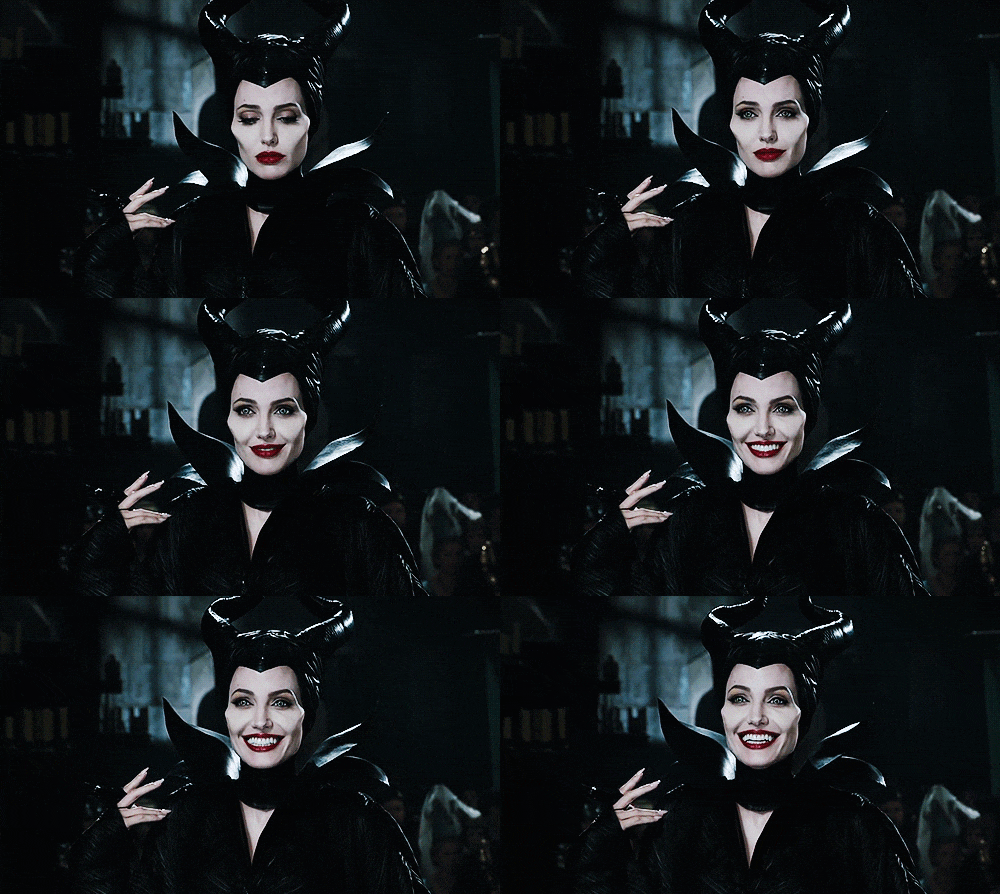
I have always felt that just because you are critical of something, does not mean you need to hate it. In the slidedeck, the relationship between pleasure and critique is discussed, which is something that I try to approach logically in general. I think it is okay to enjoy something that you grew up with, but I think that it is also very important to be critical of these things. This is why the adaptations of these stories are important. A lot of people groan when they hear that Disney is doing another live-action remake, but with many of these adaptations, they work towards being a tad bit more inclusive than the original. Don't get me wrong, there are still plenty of problematic aspects of these films (still follows the beautiful girl narrative), but with some of them we see some parts being adjusted. For instance, we get a new spin on the villain in the movie Maleficent, where the women in this movie are more empowered. It is not the prince that saves the day, but the almost mother-like bond between the characters that does. 

I felt that Maleficent did a great job working to change the narrative (although admittedly I have not seen it in several years and my opinion could be different now). I don't feel like other live action remakes lived up to the same potential though, as Cinderella and Beauty and the Beast didn't feel like they were drastically altered. Another good example of a live action being adapted in a way that provides more representation than just another white girl is The Little Mermaid, which received major backlash from

adults who couldn't get over a fictional creature (one that is originally green in the Hans Christian Anderson story and dies at the end) not being a white red-head. I saw a lot of people say things like "But Disney already had a black princess (Tiana)", as if there could only be ONE black character in Disney history. Also, while Tiana is a PoC, she spends the majority of the film as a frog, and as Christensen points out "upholds the class bias central to princess scripts" (180). Disney definitely still has a long way to go, but I suppose slow progress is better than no progress.

During my undergraduate career, I created a unit that critically analyzed fairytales, and I also got the chance to teach it during student teaching, and then again during my first year teaching. The end goal of my unit was for students to create an adaptation of a fairytale that was more inclusive than the popular version of the fairytale, which you can check out here and even use if you would like to! A part of me is hoping that I will have the chance to teach this unit again, especially now that I have even more knowledge on the topic from Christensen's piece and the slide deck! 

Final Digital Literacy Project: PECHA KUCHA & Narrative

PECHA KUCHA Unedited  Click me !!   Not sure how the video ended up longer- I triple checked that the transitions were set to 20000 (20 seco...